
What Is B to B Sales?
What is B to B sales? It is the process of one business selling products or services to another business. The buyer is usually a group, so users, budget holders and technical reviewers each have a say. For that reason, selling to buying committees is central to any B2B sales definition.
A SaaS example shows how this works. One vendor selling HR software pitches the head of people. Then the IT lead checks security, finance approves the budget and the CEO signs off. This pattern is typical of B2B SaaS sales, and deals often take months. A services deal looks similar. An engineering consultancy offering cloud migration must convince the CTO, a procurement team and a legal reviewer before anyone signs.
This guide to B to B sales is for founders and revenue leaders who are opening Europe. Germany is the test case, because buyers there need four to six touchpoints and check for local presence early. As a result, a home-market playbook rarely transfers unchanged. Each step below fits into a wider B2B go to market strategy, so you can test the market with data before committing to a full local team.
How B to B Sales Differs From B2C Sales
The gap between B2B vs B2C sales is easy to see in the numbers. A consumer purchase usually involves one buyer, a basket worth under €100 and no contract. A business purchase involves several buyers, a deal worth €10,000 or more and a term of 12 to 36 months.
Trust also carries more weight in B2B. Buyers ask for customer references, case studies and proof that you operate in their market. In Germany, for example, they also check for a local address, a German-language website and clear data protection terms.
For these reasons, a single ad click rarely closes a B2B deal. The person who clicks is seldom the person who signs. Finance, IT, legal and a department lead all review the purchase, and each one asks different questions.
The B2B buyer journey therefore includes research, internal discussion, vendor comparison and procurement review. Mapping your B2B decision makers shows which concerns you must answer at each step. This is also where B2B marketing vs sales roles meet: marketing earns attention, and sales turns it into a conversation.
Sales Cycle Length and Deal Size in B2B
B2B sales cycle length depends on price and on how many people must approve the purchase. SME software deals usually close in 30 to 90 days. Mid market and enterprise deals take 3 to 9 months, and procurement or security reviews can add more.
Average deal size rises with that timeline. An SME contract may be worth a few thousand euros a year, while an enterprise contract can reach six figures. Larger deals also involve more stakeholders, so stakeholder mapping starts on the first call.
For a founder entering a new market, this creates a timing problem. Closed revenue arrives late, so it cannot show whether the market responds in the first quarter. Sales velocity also needs enough deals before it means anything. Early on, track signals that appear sooner:
- Replies from the right job titles
- Discovery calls booked per 100 contacts
- Second meetings that include a new stakeholder
- Qualified opportunities created within 90 days
These signals show traction months before a contract is signed. As a result, you can give your board data instead of waiting for revenue.
The B to B sales process step by step
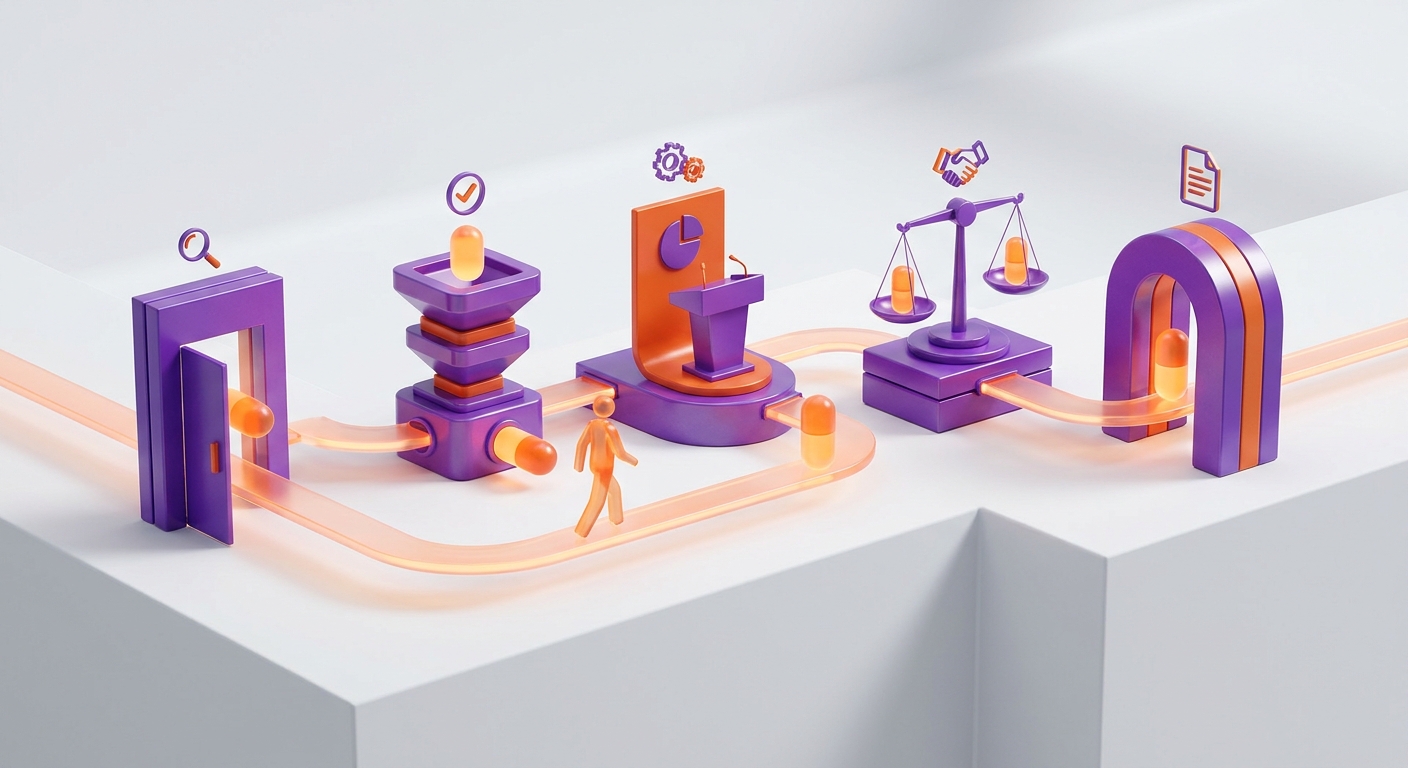
A B2B sales process moves a buyer through fixed sales stages. Each stage needs one output, so your team knows when a deal can advance. Copy the list below into your CRM as stage names and exit criteria.
- Research: build a target account list with one named decision maker per company.
- Outreach: send four to six touchpoints, then log every reply and bounce.
- Discovery: hold a call and record the buyer's problem, budget and timeline.
- Demo: show the product against that problem and note who else must approve.
- Proposal: send a priced offer with a decision date.
- Negotiation: agree terms, including a data processing agreement for GDPR.
- Close: sign the contract and hand the account to onboarding.
Each output becomes a required field in your CRM pipeline setup. A deal cannot move forward until the field is filled. As a result, your pipeline numbers show real progress instead of hopeful guesses.
Then write the stages, scripts and exit rules into a sales playbook template. In short, the playbook lets a new rep run the same process without guessing.
Prospecting and qualification
Good B2B prospecting starts with a target account list, not a contact list. Define your ideal customer by industry, company size, tech stack and a trigger such as a new funding round. Then build a list of 100 to 200 matching accounts, because a short list lets you personalise every message.
Next, source two or three contacts per account from LinkedIn, the company website and your CRM. In Germany, check GDPR and UWG rules before any cold email. Use business addresses and document your legitimate interest. Effective B2B lead generation also adds touchpoints beyond email, since German buyers need several before they reply.
Then qualify each lead with a simple lead qualification framework. BANT checks budget, authority, need and timing, and it suits deals under roughly €20,000. MEDDIC adds metrics, economic buyer and champion for longer cycles. So the BANT vs MEDDIC choice depends on deal size.
A qualified lead has confirmed budget, a defined need and a decision timeline within six months. Confirmation happens during a booked discovery call.
Discovery, demo and proposal
Start with discovery call questions that expose the problem and its cost. Ask how the team handles the task today and what a delay costs per month. Then ask who else signs off, because German buying committees often include IT, legal and a works council representative.
Build the demo around the answers you collected. Apply product demo best practices and show only the workflows that match the stated problem. A buyer who sees their own process on screen needs fewer touchpoints to trust you.
German buyers usually expect written detail and references before they ask for a proposal. So send a short technical summary, a draft data processing agreement and two customer references from the DACH region. This also settles GDPR questions early, before they stall the deal.
Write the proposal so one person can forward it without explaining it. Use a sales proposal template with a one page summary, scope, price, timeline and success metrics. As a result, each reader on the committee finds their answer quickly.
Negotiation and closing in German B2B deals
German buyers rarely push hard on price, but they ask for detail. Expect questions on what each line item covers, and prepare a clear breakdown. Good B2B negotiation tactics here mean trading scope or contract length for price, because an unconditional discount signals weak value.
Next comes the procurement process. Larger companies often require supplier forms, security questionnaires and references from other European customers. Ask your champion early who sits in procurement, then send the documents before anyone requests them.
Legal review follows. A data processing agreement is a standard item in European deals, so have your template ready before you send the first contract draft. Also list your subprocessors and hosting locations, since German legal teams check both.
Finally, closing B2B deals depends on a clear signature path. Agree on who signs, which format the buyer accepts and the target date. Electronic signatures are widely accepted, but some companies still want a signed PDF from an authorised signatory. As a result, confirm this during legal review instead of at the end.
B to B sales strategy: ICP, positioning and pricing
A B2B sales strategy comes before any outreach. Without one, your emails reach the wrong companies with the wrong message, and German buyers ignore them. So spend the first weeks on research before you write a single sequence.
Start with your ideal customer profile. Combine firmographic criteria with problem-based ones:
- Company size, industry, revenue range and region within DACH
- Tech stack and compliance requirements
- The specific problem the buyer must solve this year, and the trigger that makes it urgent
Next, run a competitor analysis. List the vendors German buyers already use, then note how they position themselves and where they have local presence. After that, collect pricing benchmarks from public price pages, review sites and buyer calls, because prices that ignore local norms raise doubts. Finally, apply market sizing to count how many accounts fit your profile.
Before you scale, complete ICP validation through 15 to 20 buyer conversations. Ask what they use today, what they pay and what would make them switch. If the same objection appears in five calls, change the positioning first. Then build your outreach on what those calls showed you.
Account based selling for small target lists
Account based sales suits teams that cannot fund a full SDR team. Instead of contacting thousands of leads, you pick 50 to 100 named accounts in Germany and work each one closely. Choose them by fit: company size, industry, tech stack and a clear trigger such as a funding round or a new hire.
Next, map two to four contacts per account. This multi threading matters because German purchases involve several people, for example a department head, a daily user and an IT or data protection lead. If one contact stays silent, the others keep the account alive.
Then coordinate the channels. Send an email first, follow with LinkedIn outreach for B2B two days later, and place a phone call before the week ends. Each touchpoint refers to the same account insight, so buyers see consistent messaging. This also builds toward the four to six touches German buyers expect.
The model fits small budgets because effort goes only to accounts you can realistically win. One person can run 75 accounts alongside a light account based marketing plan, such as targeted LinkedIn ads or a German-language case study. As a result, you can measure pipeline within 90 days without a €60,000 SDR hire.
B to B sales models: inside, field, channel and self serve
The model you pick decides how fast you learn and how much you spend before you know whether Germany works. Each one fits a different deal size.
- Inside sales: deals of €5,000 to €30,000 a year, €150 to €400 per meeting, first results in four to six weeks.
- Field sales: deals above €50,000, €800 to €1,500 per meeting, feedback after several months.
- Channel: deals of €10,000 to €50,000, low cost per meeting because the partner opens doors, but three to six months to ramp.
- Self serve: deals under €5,000, no meeting cost, a clear signal within weeks if the product and pricing pages are in German.
For a company of 10 to 100 employees testing a new country, inside sales and self serve fit best, because they cost little and produce data quickly. The debate on inside sales vs field sales matters later, once your average deal justifies travel. Product led growth only works if buyers can sign up without a call, so it suits lower priced tools. Outsourced sales also gives you inside capacity without a €60,000 hire.
Partners are the exception to slow channel ramps. Channel sales partners and resellers already hold the trust German buyers look for, so you borrow their local presence. Still, start with one or two and test them against a clear pipeline target. Sales model selection should follow your deal size.
B to B sales funnel and pipeline metrics
A B2B sales funnel has five stages you can count: emails sent, replies, meetings booked, qualified opportunities and pipeline value. Track each one weekly, because a drop at one stage points to a specific fix.
The ranges below are starting points, but your own conversion rate benchmarks will shift with deal size and industry.
- Emails sent: 200 to 300 per week per sequence, spread across four to six touchpoints.
- Reply rate: 3% to 8%, though cold email reply rates in DACH often sit at the lower end.
- Meetings booked: 1% to 3% of contacts reached.
- Qualified opportunities: 30% to 50% of meetings held.
- Pipeline value: three to four times your revenue target, which is the usual pipeline coverage ratio.
Only some of these sales KPIs prove market fit, so within 90 days focus on positive reply rate, meeting to opportunity conversion and pipeline coverage. If positive replies reach about 2% and at least 30% of meetings become qualified opportunities, the offer fits.
A low reply rate alone is not enough to call the offer a failure. Instead, check your message, your ICP and your local presence signals first, then change one variable at a time.
B to B Sales in Germany and DACH: What Changes
Home market outbound playbooks for B to B sales get silence in Germany. A typical sequence runs three emails over two weeks and then stops. German buyers evaluate slowly and carefully, so the sequence ends before the buyer has formed an opinion.
Buyers usually need four to six touchpoints before they take a call seriously. Each touch has to add information, so a "just checking in" follow-up gets ignored. Before any of that, they check whether your company exists locally.
A prospect who reads your first email will look for these signals:
- A German language website and sales materials
- An imprint (Impressum) with a registered company address
- A local phone number with a German or DACH area code
- References from companies in Germany, Austria or Switzerland
Missing one of these is often enough to end the conversation. Sales outreach in German also needs more than translation, because tone and the formal "Sie" shape how credible you sound. B2B localization covers all of it, from the pitch to the case studies.
For DACH market entry, build the trust signals first and start sequencing second. Then plan six touchpoints across email, LinkedIn and phone over four to six weeks. As a result, you can judge replies against a realistic benchmark.
Touchpoints, Local Presence and Language
German buyers rarely answer a first message. A multichannel outreach sequence gives them time to check who you are, so plan six touchpoints on a schedule like this one.
- Day 1: a short email in German with one problem and one question.
- Day 4: a LinkedIn connection request without a pitch.
- Day 10: a follow-up email with a relevant case study.
- Day 17: a LinkedIn message that refers to the earlier email.
- Day 24: a phone call, followed by a voicemail if nobody picks up.
- Day 35: a closing email that offers one clear next step.
Prospects check your credibility between these steps, so the groundwork has to exist before message one. Put these trust signals B2B buyers look for in place first:
- German website localization covering the homepage, product, pricing and contact pages, plus a German imprint (Impressum) and privacy policy.
- A local address or entity, which gives buyers local presence Germany they can verify.
- Case studies from European or German clients, with named results.
- A German-speaking contact who answers calls and replies in the buyer's language.
Without these, even a well-timed sequence reads as a cold message from a stranger. With them, each touchpoint adds to a picture that holds up when the buyer searches your name.
GDPR and Cold Outreach Rules in Germany
Two laws apply at once. GDPR governs how you collect and process contact data, while the UWG, the German unfair competition act, governs how you contact people. Passing one test does not clear the other, so GDPR B2B email marketing plans must satisfy both.
For data processing, legitimate interest under Article 6(1)(f) can cover B2B prospecting if the message is relevant to the recipient's role. You must also tell them where you got their data. The UWG cold outreach rules are stricter. Cold email requires prior consent, even between businesses, so a purchased list carries real risk. Phone calls to businesses are allowed when you can show presumed consent, meaning a clear link between your offer and the prospect's work.
As a result, GDPR compliant lead generation often relies on consent-based channels such as events, content downloads and double opt in forms. Existing customers are a narrow exception, and only under set conditions.
Whichever channel you choose, set up these basics:
- Honor every opt-out immediately and add the address to a suppression list.
- Record the source, date and wording of each consent.
- Include a privacy notice and your full company details in the first message.
This section is general information, not legal advice. A local German lawyer should review your final setup before the first email or call goes out.
Building a B2B Sales Team vs Outsourcing in a New Market
The SDR cost Germany brings starts at €60,000 per year once salary, overhead and recruiting are counted. A B2B sales consultant charges €15,000 or more for a strategy deck, but the deck books no meetings. An outsourced SDR or outbound partner bills monthly, so you pay only for the months you run.
Hiring a sales team abroad gives you the most control. However, it is also the slowest route, because recruiting and onboarding take months. So if the market does not respond, you still carry the salary.
With sales outsourcing, you can start in weeks and stop after one quarter. You give up some control over messaging, but you also limit your risk while market fit is unproven.
Before you sign with a partner, check these points:
- Native German speakers write and send every message.
- A documented GDPR process covers data sourcing and opt-outs.
- Weekly reporting shows meetings, replies and pipeline.
- The contract runs three months instead of twelve.
A 90 Day Plan to Test B to B Sales in a New Market
A 90 day market entry plan tests whether demand exists before you hire locally. It forms the foundation of a sound European expansion strategy, and a go to market plan template keeps execution on track.
- Weeks 1 to 3: size the market, validate your ICP, map competitors, benchmark prices and set up GDPR compliance.
- Weeks 4 to 6: build German language assets, then launch the first outreach waves.
- Weeks 7 to 12: follow up, book meetings and review the qualified pipeline.
German buyers need four to six touchpoints before they commit. Most of your results come from the follow ups in weeks 7 to 12.
Pipeline proof for investors requires numbers you can defend. After 90 days, your board should see:
- 8 to 12 qualified meetings with ICP accounts
- 3 to 5 opportunities with budget and a named decision maker
- Pipeline value of at least three times the test budget
If you have fewer than four meetings by week 10 despite six touchpoints per account, stop. If opportunities hit your targets and buyers confirm your pricing, expand.
We can run this test for you. Ask about our B2B lead generation services and book a scoping call to plan weeks 1 to 3.
Frequently Asked Questions
What is B to B sales?
B to B sales is the process of selling products or services from one business to another. The buyer is a company with a budget, so deals usually involve several decision makers and a longer sales cycle. For example, a software vendor that sells payroll tools to a manufacturer runs B to B sales.
How does B to B sales differ from selling to consumers?
Consumers usually decide alone and buy within minutes or days. Business buyers compare vendors, ask for internal approval and often request references. As a result, B to B sales relies on a defined ideal customer profile, repeated contact and proof of results.
What are the main stages of a B to B sales process?
Most teams work through prospecting, qualification, discovery, proposal, negotiation and close. Each stage needs a clear owner and an exit criterion, so deals do not stall unnoticed. Finally, a review of conversion rates between stages shows where the pipeline leaks.
How long does B to B sales take in Germany?
German buyers typically need four to six touchpoints before they take a call seriously, and they check for local presence before they assess the offer. Therefore, a first meeting can take several weeks of outreach. Full sales cycles in DACH often run three to nine months, depending on deal size.
How does GDPR affect B to B sales outreach in Germany?
GDPR applies to business contact data, and German competition law adds its own limits on cold email. Cold email to companies generally requires prior consent, so many teams use LinkedIn, events and compliant phone outreach instead. Document your legal basis for each channel and confirm the setup with a data protection lawyer.
Can a small company run B to B sales in Europe without a local SDR?
Yes, if you test the market before you hire. A local SDR costs €60,000 or more per year, so a 90 day outbound pilot with clear pipeline targets carries less risk. Then you can decide on a permanent hire based on booked meetings and qualified opportunities.