

GTM Strategy Template for Market Entry: The Execution Framework That Actually Works
Market entry is not a marketing problem. It's an execution problem. Most founders assume that translating their pitch into the local language and buying a contact list counts as a go-to-market strategy template. It doesn't—it's a fast way to burn trust in markets that punish shortcuts. German B2B buyers need four to six touchpoints before they take a call seriously, and they verify local presence before they evaluate your offer. That's not a cultural quirk to work around. It's the rulebook.
Skip structural prerequisites, and even a great product looks like a stranger knocking on the wrong door. Follow a disciplined GTM strategy template, and the same product becomes credible within weeks. The difference isn't budget. It's structure.
Why GTM Strategy Fails Before Tactics Begin
Most market entry attempts collapse before the first outreach email lands. The founder has research, budget, and genuine product-market fit. What they lack is a go-to-market strategy framework built on execution prerequisites—not guesses about what might work, but structural decisions that precede every tactic.
The Translation Trap
Translating your pitch deck and buying a contact list creates the illusion of strategy. Translation signals that you haven't invested in understanding the market—you've invested in speed. German B2B buyers notice this immediately. A translated pitch without local case studies, without market-specific messaging, without evidence that you understand German buyer psychology, reads as a shortcut. Trust collapses before conversation begins.
Localization extends far beyond language translation to cultural adaptation, regulatory messaging, and proof of local market knowledge. This distinction determines whether your market entry checklist becomes a foundation for growth or a list of wasted activities.
Touchpoint Math You're Ignoring
German B2B buyers require four to six touchpoints before they take a meeting seriously. Most founders underestimate this. They send two emails, make one call, and declare the market unresponsive. The market isn't unresponsive—the founder hasn't completed the required sequence. Without structured cadence, your outreach looks disorganized. With it, the same effort converts at rates that justify investment.
A proper market entry checklist specifies exact timing and format: when the first email lands, when the call follows, what content bridges each gap, when follow-ups arrive. This sequencing is non-negotiable. It's the spine of your GTM strategy template.
Local Presence as Credibility Signal
German buyers verify local presence before they evaluate product features. Local presence means messaging that addresses market-specific problems, case studies from companies in their region, a sales process that reflects how German businesses prefer to buy. It means demonstrating market understanding, not just market entry.
Without these signals, you're asking a German buyer to trust a stranger. With them, you're asking them to trust a vendor who has done the work. That structural difference determines whether your go-to-market strategy framework scales or stalls.
The GTM Strategy Template: Five Structural Phases
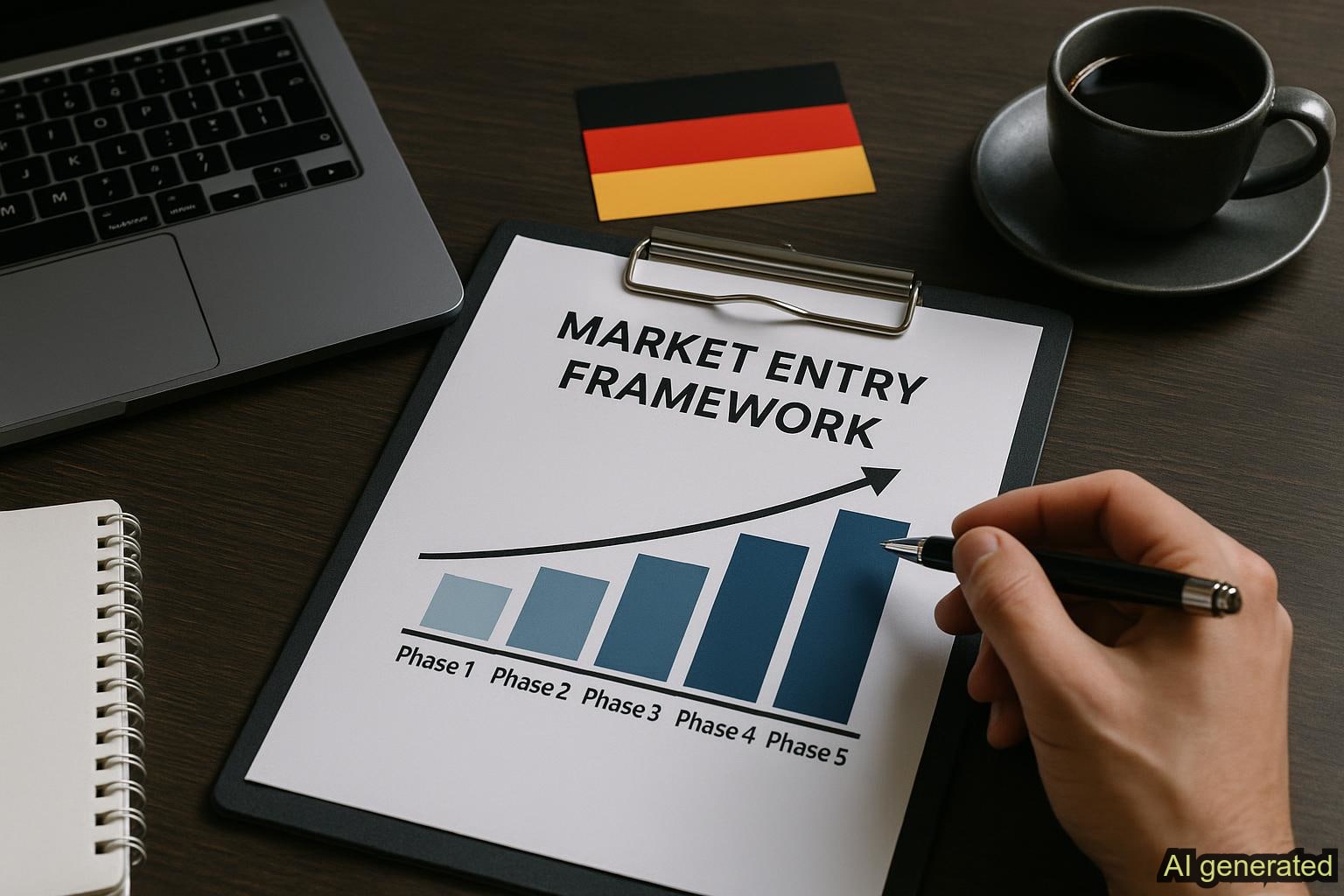
A proper go-to-market strategy framework moves through five distinct phases. Each phase is a gate. You must pass one before advancing to the next. Skipping phases or running them in parallel is how credibility collapses and budget burns.
Phase 1: Pre-Launch Research & ICP Validation
Before you localize anything, you need to know exactly who you're selling to and whether they exist in sufficient numbers to justify entry. This phase involves market sizing (TAM in your target region), buyer profile refinement (does your ICP hold in this market?), competitive landscape audit (who owns mindshare?), and regulatory or compliance checks specific to the industry and country.
- What is the addressable market size in your target region?
- Does your ideal customer profile remain constant, or do buyer priorities shift?
- Who are the top three competitive alternatives in this market?
- What compliance, data privacy, or industry-specific regulations affect your approach?
- How many prospects match your ICP and are accessible within six months?
- What are the top three buying triggers for your solution in this market?
- Are there local gatekeepers (consultants, industry bodies) who influence buyer perception?
- What is the average sales cycle length for similar solutions in this region?
Answer these eight questions with data before advancing to Phase 2. If you cannot answer them with conviction, your market entry checklist is incomplete, and your GTM strategy template will fail at execution.
Phase 2: Localization Audit (Beyond Language)
Localization is not translation. It is cultural and market adaptation. It includes messaging tone shifts (German B2B communication favors directness and efficiency), local case studies and proof points (prospects want to see companies like themselves using your solution), regulatory messaging adjustments (compliance language that speaks to local concerns), and sales process customization (how meetings are scheduled, how decisions are made, how contracts are structured).
This phase typically takes four to six weeks. It is non-negotiable. Skipping it means your go-to-market strategy framework is built on shortcuts. A proper market entry checklist isolates the specific localization work needed before outreach begins.
Phase 3: Touchpoint Sequencing (4–6 Contact Cadence)
This phase designs the exact customer journey. It maps touchpoints in order: timing between email one and email two, when the first call lands, what content (case study, webinar, article) bridges each gap, when follow-ups arrive, and how channels alternate (email, LinkedIn, phone, content) to maintain engagement without triggering spam filters or buyer fatigue.
A basic GTM strategy template sequences it this way: Email 1 (day 1), Email 2 (day 5), Phone call (day 7), Email 3 with content asset (day 10), Email 4 with social proof (day 15), Final email or breakup sequence (day 21). This is the minimum viable sequence for German markets. The point is that every touchpoint is deliberate, timed, and supported by materials prepared in Phase 2. This sequencing is what differentiates a go-to-market strategy framework from random outreach.
Phase 4: Sales Enablement & Messaging Lock
Before your team begins outreach, every piece of messaging must be locked. This means localized sales collateral, documented objection handling for market-specific concerns (price positioning in this market, regulatory questions unique to the region), team briefing on cultural nuances, and message hierarchy by buyer persona so that different conversations address different priorities.
This phase prevents the silent killer of GTM execution: inconsistent messaging across channels. If your website emphasizes one value prop, your email emphasizes another, and your sales call introduces a third, trust erodes. German buyers cross-reference these channels. A proper market entry checklist locks all messaging before execution begins.
Phase 5: Execution & Measurement Gates
Execution means running the sequence at scale while measuring results at each gate. This phase defines success metrics: response rate to email one, meeting booking rate after calls, pipeline velocity by touchpoint, and cost per qualified meeting. It establishes decision rules: if response rate falls below threshold, pause and audit messaging. If meetings hold but pipeline velocity stalls, the problem is discovery, not outreach.
Without these gates, you'll scale a broken go-to-market strategy framework. With them, you'll know precisely what's working within two weeks of launch. This GTM strategy template approach prevents the common mistake of expanding volume before validating process.
Template in Action: Real Constraints to Plan For
A GTM strategy template is useless if it ignores execution reality. Here's what timeline, budget, and resourcing actually look like for market entry checklist execution.
Timeline Expectations (Weeks, Not Years)
Phases 1 and 2 (research and localization audit) typically consume four to six weeks. Phases 3 and 4 (sequencing and enablement) add another four to six weeks. Phase 5 (execution and measurement) begins in week 8 or 9. First qualified meetings often arrive by week 9 or 10 of the outreach sequence. The entire process from decision to repeatable process takes three to four months, not six to twelve. Rushing any phase compounds into months of wasted outreach later. A market entry checklist that compresses timeline always creates downstream work.
Budget Allocation by Phase
| Phase | Allocation | Primary Expense |
| Phase 1–2: Research & Localization | 30% | Market research, local expertise, messaging development |
| Phase 3–4: Enablement & Messaging | 25% | Collateral design, sales training, content creation |
| Phase 5: Execution & Tooling | 30% | CRM, email infrastructure, sales tools, list sourcing |
| Measurement & Iteration | 15% | Analytics, testing, process refinement |
This allocation reflects structural spend required to build credible go-to-market strategy framework. It's not inflated customer acquisition cost. It's the investment required to establish repeatable process before scaling volume.
Hiring vs. Outsourcing Decisions
Phases 1 and 2 benefit most from local market expertise. You can hire a market lead, partner with a local agency, or work with a GTM partner who has on-ground presence. Phases 3 and 4 can be partially templated internally once localization is complete. Phase 5 is execution—it can be run by your team, a sales development team you hire, or an outsourced development partner. The decision depends on cash position, timeline pressure, and whether you plan to maintain the market long-term. A market entry checklist built by local experts in Phase 1–2 enables faster, smarter decisions in Phase 3–5.
Common Execution Risks & How to Avoid Them
These are the failure modes that derail founders after they've committed budget. They're where most GTM strategy frameworks break during execution.
Premature Scaling Before Credibility
You see response to your first 200 emails. It looks promising. You immediately expand to 2,000 emails. You're now running volume through a sequence you haven't validated at scale. Response rates collapse. You assume the market is weak. What actually happened: you scaled before credibility gates were proven. A proper market entry checklist runs the full 4–6 touchpoint sequence with a small cohort (200–500 prospects) until you've established repeatable metrics. Only then do you scale volume.
This validation takes two to three weeks. Skip this gate, and 10,000 emails look like spam. Build the GTM strategy template first, and the same volume drives consistent meetings.
Inconsistent Local Messaging Across Channels
Your website emphasizes one value prop. Your email emphasizes another. Your sales call introduces a third. German buyers cross-reference these channels. They notice misalignment. Trust erodes immediately. A proper GTM strategy template locks messaging in Phase 4 across all channels: website, email sequences, LinkedIn profiles, collateral, call scripts, objection handling. Every channel must speak the same language about the same value prop.
Audit your messaging now. List every channel your prospect encounters. Write down the main claim in each channel. If they're not aligned, you have a credibility leak. This is foundational to your market entry checklist.
Next Steps: Build Your Market Entry
You now have the structure. Use it. Work through each phase in order. Don't skip gates. Don't compress timeline. The difference between founders who execute successful market expansion and those who burn budget on shortcuts is disciplined execution of structural prerequisites before tactics begin.
A GTM strategy template is a diagnostic tool. If you can't answer the Phase 1 validation questions with conviction, you're not ready for Phase 2. Stay disciplined. Your market entry checklist and go-to-market strategy framework are only valuable if you implement them completely.
Frequently Asked Questions
How long does it take to see the first meeting using this GTM strategy template?
If you execute Phases 1–4 correctly (eight to twelve weeks), you'll typically see the first qualified meeting by week 9 or 10 of the sequence. The full 4–6 touchpoint cycle often requires three to four weeks before a prospect is ready to take a call. Patience in sequencing is the trade-off for credibility when implementing your go-to-market strategy framework.
Can I run this market entry checklist for multiple markets at once?
No. Each market requires its own Phase 1–2 work. Running this GTM strategy template for Germany, Austria, and Switzerland in parallel spreads focus and dilutes credibility signals. Start with one market, build repeatable process, then add a second. This is slower than simultaneous expansion but far more likely to succeed.
What if my product doesn't have local case studies yet?
You'll develop them during Phase 2 and Phase 5. Until then, use case studies from similar markets (e.g., Austria for Germany, or UK for European expansion). Frame them as reflecting similar market dynamics. This is honest and better than claiming non-existent local proof. A GTM strategy template accounts for this by establishing which proof points you have now and which you'll build during execution.
Should I hire a local sales rep before or after running this GTM strategy template?
After you've completed Phases 1–4. A local sales rep without a validated go-to-market strategy framework will create chaos and burn budget without learning what works. First, build process. Then hire people to scale it. Hiring first is how founders mistake early effort for repeatable execution.
What's the difference between this approach and hiring a local agency to manage outreach?
An agency executes tactics. This GTM strategy template builds structure. You need both, but structure comes first. Without it, an agency will execute a broken process at scale. Use this framework to define what needs to be done (Phases 1–4), then decide whether your team or an outsourced partner executes Phase 5. The thinking is yours. The execution can be delegated. Your market entry checklist ensures you're thinking strategically before you hand off tactically.
Can I adapt this market entry checklist for other European markets?
Yes. The structure (five phases, touchpoint sequencing, localization audit) is universal. The details change by market. Germany values directness and efficiency; UK buyers prefer relationship-building; France demands intellectual rigor in pitch. The GTM strategy template framework is the same. The localization work in Phase 2 is market-specific. Your go-to-market strategy framework becomes a replicable asset across regions once you build it once.
SalesRealizer runs your full market entry into Germany, DACH, Europe & India—ICP research, outbound, AI agents, and sales automation, all done for you. Built by Europeans who know the market.