

Go to Market Strategy Example PDF: What a DACH-Ready Plan Actually Contains
What a Go to Market Strategy Example PDF Should Actually Contain
Search for a go to market strategy example PDF and you will find 40-slide decks built for US self-serve SaaS. Freemium funnels, product-led growth loops, viral coefficients. None of it survives contact with a German procurement process. Entering Germany is not a marketing problem. It's an execution problem. The document you need tells your team what to do on Monday morning. It does not describe a category.
A usable document covers seven components. Here is what each one looks like when it is filled in for DACH rather than filled in generically.
Market sizing with German-specific figures. Not "Europe is a $40bn market." Calculate TAM and SAM from German company registries, industry associations and employee-count bands. Then state how many accounts actually match your criteria. If the SAM is 380 companies, the document says 380. Company data is public and checkable through the Handelsregister, so estimates are not needed where counts exist.
A validated ICP, not a persona sketch. ICP validation means buyer titles as they appear on German org charts: Geschäftsführer, Einkaufsleiter, IT-Leiter, Bereichsleiter. It also names who blocks the deal, often procurement or the Betriebsrat. And it names the person who never appears in your CRM but signs anyway.
Competitor mapping that includes local incumbents. The German competitor set usually holds three or four vendors with no English website, no G2 presence and 20 years of reference customers. They rarely show up in English-language research. They are the reason your deals stall.
Pricing benchmarks in euros, with procurement terms. List price ranges from comparable German vendors. Add what German buyers expect on payment terms, contract length and notice periods (Kündigungsfrist). Say whether annual prepay is realistic in your segment.
Channel mix based on where your buyers already are. Trade associations, industry-specific Fachmedien, regional events, LinkedIn versus Xing by seniority, partner and reseller routes. Rank them by cost per qualified conversation, not by reach. Our breakdown of SaaS marketing channels by market covers how that ranking shifts between DACH and English-speaking regions.
A touchpoint sequence. German B2B buyers need four to six touchpoints before they take a call seriously. They check for local presence before they check anything else about your offer. The sequence names each touch, its channel, its language and its interval.
A 90-day measurement plan. Named accounts contacted, conversations held, qualified opportunities, average deal value observed. Set thresholds that tell you to continue, adjust or stop.
A PDF is an output. The strategy is the evidence behind each field. A template gives you empty boxes. What makes the document worth anything is that every figure came from a source you can point to. For a worked version with numbers filled in, see this go-to-market strategy example for entering Germany.
Go to Market Strategy for Startups: Why the Home-Market Playbook Goes Silent in Germany
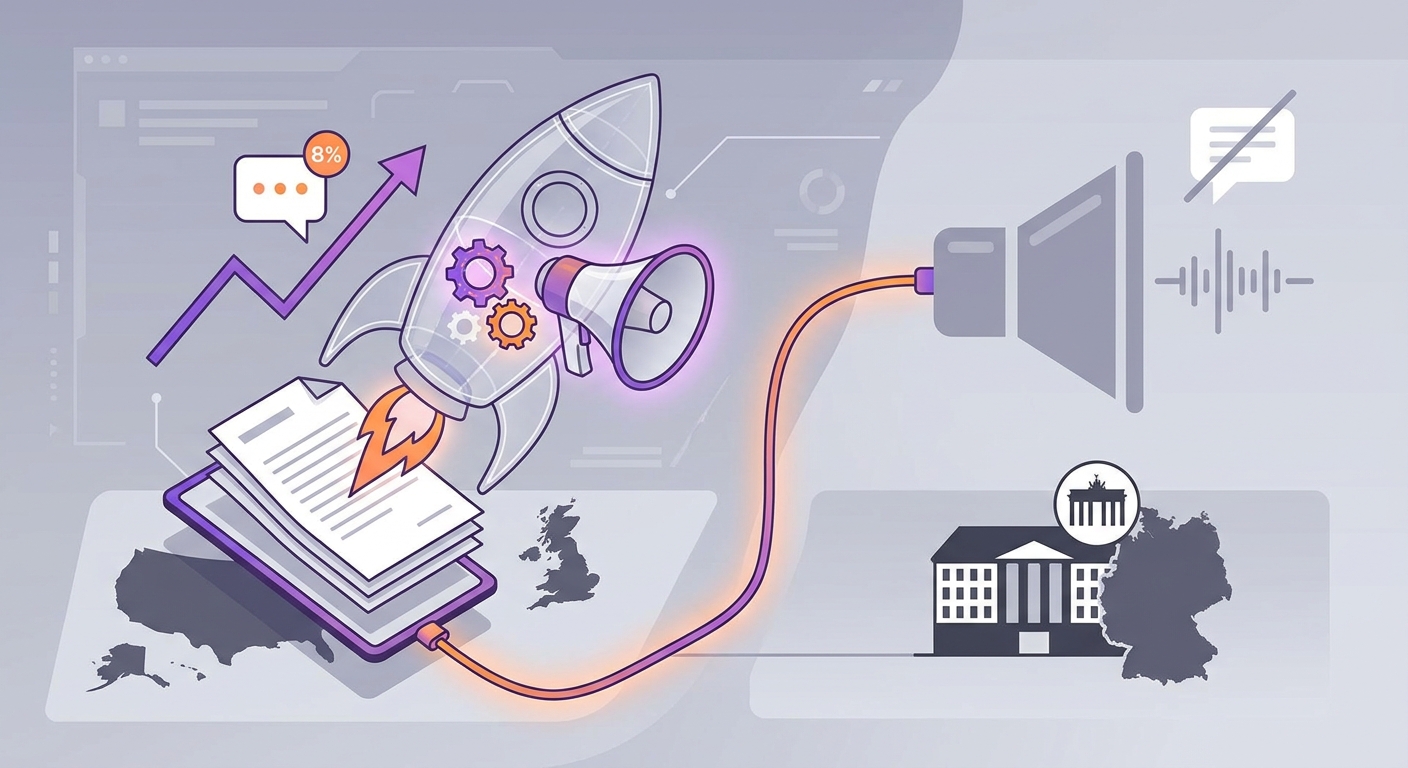
A go to market strategy for startups that produced 4 to 8 percent reply rates in the US, UK or Nordics routinely drops below 0.5 percent in Germany. The sequence did not break. The assumption behind it did. German B2B buyers need four to six touchpoints before a call request counts as serious. They also run a local presence check before they read a word about your product.
Local presence is not a brand statement. In practice it means five things a buyer can verify:
A German phone number that someone answers, not a redirect to a US switchboard.
A compliant Impressum on your website. It is legally required and the first thing a procurement lead looks for.
German-language collateral: one-pager, pricing logic, security documentation.
A named contact who replies in German, with a real title and a real inbox.
References from German or DACH customers, or at least from the same industry inside the EU.
Miss three of these and your email is filed as foreign spam. Nobody gets as far as your value proposition.
The Three Assumptions That Break First
Translation equals localisation. DeepL output reads as DeepL output. A buyer who spots machine German assumes the rest of the operation is just as thin. Cost: a full sending domain warmed over six weeks, then burned in ten days of low engagement and spam complaints.
Volume compensates for relevance. A 5,000-contact scraped list in Germany carries GDPR exposure and a soft bounce rate of 20 to 30 percent. Cost: two secondary domains blacklisted, the list unusable, and roughly €4,000 in tooling and data spend with no meetings booked.
Speed of follow-up signals eagerness. Three emails in five days reads as pressure, not enthusiasm. German buyers read fast escalation as a sign that you need the deal more than they do. Cost: the accounts you most wanted are now closed to you through that contact.
What Replaces Them
Sequence the entry instead of compressing it. The execution-first approach to a go-to-market strategy for startups sets the order.
First, run 15 to 25 ICP validation interviews with German operators before a single campaign launches. You are testing one thing: whether the problem you solve is the problem they name, in the words they use.
Second, anchor the first offer in a specific operational problem, not a product category. "Reduce onboarding time for new field technicians" lands. "AI-powered workforce platform" does not.
Third, build German proof assets before the first email leaves. That means a case study, a security overview and a pricing page. Then design outbound sequencing across four to six touchpoints spread over three to four weeks. Mix email, LinkedIn and one phone attempt from a German number.
Building a Go to Market Plan for the DACH Region in 90 Days
A go to market plan for Germany, Austria and Switzerland works when it reads as a schedule with named owners. It fails when it reads as a strategy deck. Four blocks, 90 days, each with deliverables someone signs off on. Lift the structure below into your own go-to-market plan template and fill in names and dates. The 90-day DACH market entry plan goes deeper on sequencing within each block.
Block 0: Owners and Decision Rights (Week 1)
Founder or CEO: ICP sign-off, pricing approval, go/no-go at day 90.
Revenue lead: sequence design, CRM configuration, weekly pipeline review.
Native German speaker: all outbound copy, call handling, objection logging. Not optional, not a translation tool.
Days 1 to 30: Evidence Before Outreach
Deliverables: market sizing with segment counts. A written ICP with firmographic and trigger criteria. A competitor and pricing benchmark table covering five to eight local alternatives. Messaging tested in three to five conversations with real German buyers.
No emails go out in this window. The cost of a wrong message in Germany is reputational, not statistical. A mistargeted campaign in a 200-account segment does more than produce a low reply rate. It marks your domain and your company name with the exact buyers you will need again in six months. DACH industries talk internally through associations and peer networks. You do not get a clean second attempt at the same list.
Days 31 to 60: Infrastructure and First Contact
German-language website page, one-pager and case study. Written, not translated.
Separate sending domain, warmed for at least 14 days, with SPF, DKIM and DMARC configured.
CRM fields for legal entity form, Handelsregister number, decision-maker title in German, GDPR lawful basis and consent source.
A DACH outbound sequence running four to six touchpoints over 18 to 24 days: email day 1, LinkedIn view and connect day 3, email day 7, call day 10, email day 14, call day 21. Where relevant, add trade association membership or a single well-chosen Messe or regional event.
Spacing matters more than volume. Same-week repetition reads as pressure. Three-week patience reads as a company that plans to stay.
Days 61 to 90: Pipeline and Iteration
Track four numbers: meeting-set rate per 100 contacted, qualified opportunity count, objection frequency by category, and message variants retired versus kept.
Realistic benchmarks for a cold DACH segment: 1.5 to 3 percent meeting-set rate on a tightly defined list, 4 to 8 qualified opportunities from 400 to 600 contacted accounts, and two of five message variants surviving the quarter. Anything above that is a strong signal. Anything below 1 percent means the ICP is wrong, not the copy. Decide at day 90 on evidence.

GDPR, Local Presence and the Compliance Layer Most Templates Skip
The fear is usually stated as "GDPR will fine us for cold email." The real risk in Germany is narrower and more practical. A competitor or a recipient sends an Abmahnung, a cease-and-desist with a fee attached, under the UWG, the German act against unfair competition. That happens far more often than a data protection authority investigation. Build your process to survive that scenario.
Two bodies of law apply at once. GDPR governs whether you may process a contact's data. GDPR-compliant B2B outreach usually rests on legitimate interest under Article 6(1)(f). That requires you to run and record a legitimate interest assessment: your purpose, why this specific contact is relevant, and why your interest outweighs their expectation of privacy. The UWG governs whether you may send the message. Section 7 treats advertising email as requiring prior consent. There is a narrow tolerance in B2B where the offer relates directly to the recipient's professional responsibility. Cold calling a business requires presumed consent, meaning a defensible argument that the specific company would expect contact about this specific problem.
A role-based address such as einkauf@ or info@ carries lower personal data exposure than a named individual's inbox. It does not remove UWG obligations. A named contact gives you better response rates and a heavier documentation burden. Choose deliberately, per segment.
What belongs in the record for every contact:
Source of the data, with date and method of collection
The documented basis for relevance to that person's role
Opt-out requests, timestamped, and how they were applied across tools
Retention period and the trigger for deletion
A signed processor agreement, an Auftragsverarbeitungsvertrag, with every vendor touching the data
Practical Guardrails
No purchased bulk lists. Ever.
Research-backed relevance recorded for each contact before first touch.
A German-language opt-out in every message, honoured within days, not weeks.
An Impressum on every landing page, signature and asset.
A documented deletion process someone owns by name.
A German entity or a local partner shifts the risk profile. Acting as controller or joint contact point, they mean correspondence arrives in German and responses come from a German address. The recipient sees an accountable party rather than an offshore sender. The discipline pays twice. Proving relevance per contact is the same work that lifts reply rates. If you are selecting software for this, the guide to sales automation tools for GDPR-compliant DACH entry covers which vendors will sign an AVV and where data is hosted.
Deciding What to Fund: Local SDR, Consultant Deck or Proof First
Three routes compete for the same budget line. They differ less in price than in when you learn whether the market wants you.
A German SDR at 60,000 euros or more per year. Add employer contributions, tooling, management time and a three to six month ramp. The first reliable signal arrives around month five, and it is confounded. A weak result could be the hire, the list, the message or the market. Downside risk is a fixed cost with German notice periods attached.
A 15,000 euro strategy deck. You get market sizing, personas and a channel plan in four to six weeks. No contact has been made, so nothing has been tested. The common outcome is a PDF in a shared drive, referenced twice, executed by nobody. Downside risk is a sunk fee and a lost quarter.
A scoped validation engagement. Fixed scope, fixed fee, documented pipeline evidence inside 90 days. Downside risk is capped at the engagement fee. The output is data you keep: real replies, real objections, real meeting rates from German buyers.
Questions to ask any provider before signing:
What exactly gets sent, and can I read every sequence before it goes out?
In whose name does it go: my domain, a subdomain, or yours? Who owns the sending reputation?
What is the GDPR legal basis for each contact, how is legitimate interest documented, and who handles objections and deletion requests?
What does reporting look like week by week, not quarter by quarter? Which numbers appear in week two?
What happens to the data, domains and sequences when the engagement ends?
Metrics a board accepts as proof: qualified meetings held, not booked; total opportunity value in the pipeline created; cost per qualified meeting compared against your blended CAC at home; and the objection log. That log is the most useful artefact you will produce. Sort it by frequency and it tells you whether you have a message problem, a market problem or a product problem. Each one calls for a different next investment.
Decision rule: commit fixed headcount only after the market has answered. Run market entry validation first, read the objection log, then hire against a proven motion rather than a hypothesis. The case for B2B lead generation in DACH without hiring locally sets out how that sequencing works in practice. Keep your go to market strategy example PDF as a living document, updated with every reply, every objection and every meeting that converts.
Frequently Asked Questions
What should a go to market strategy example PDF actually contain?
A useful go to market strategy example PDF covers market sizing for the target country, a validated ICP with named accounts, competitor and pricing benchmarks, channel selection, and a 90-day execution plan with pipeline targets. For Germany, it also needs a GDPR-compliant outreach approach and evidence of local presence. German buyers verify that before they read your value proposition. Templates that stop at positioning statements and personas leave out the parts that decide whether you book meetings.
How is a go to market strategy for startups different when the target is Germany or DACH?
A go to market strategy for startups in DACH assumes longer consideration cycles. It also assumes four to six touchpoints before a first call is treated as serious. Cold volume tactics that work in the US or UK produce silence here, so the sequence shifts toward credibility signals: German-language materials, a local address or phone presence, references, and documented compliance. Budget follows that logic, with money spent on market validation before a full-time SDR hire.
Do I need a formal go to market plan before testing the German market?
Yes, but size the go to market plan to the decision in front of you, not to a consultant's page count. Define the segment, the buying committee, the offer and price point, the outreach channels, and the metrics you will read at day 30, 60 and 90. That document is small enough to write in two weeks. It is also specific enough for real pipeline data to prove it wrong.
Where can I find a credible go to market strategy example PDF for B2B SaaS?
Most public PDFs are marketing assets from agencies and VC portfolios, so treat them as structural references rather than playbooks. Use them to check whether your own plan covers the same categories. Then replace every generic assumption with data from your target market: local competitor pricing, procurement norms, and DACH buying behaviour. An example that does not name accounts, channels and numbers cannot be executed against.
How much should a go to market plan for Europe cost before market fit is proven?
A validation-stage plan plus first outbound tests should cost a fraction of a local SDR hire, which typically runs past 60,000 euros per year fully loaded. The purpose at this stage is measurable proof: qualified conversations, discovery calls booked, and objections recorded from real German buyers. Commit to headcount only after that evidence exists.
What results should I expect in the first 90 days?
Expect the first 30 days to produce research output and a tested message, not meetings. Days 30 to 60 usually bring the first replies and discovery calls as touchpoint sequences complete. Days 60 to 90 should produce a pipeline number you can bring to your board. If no qualified conversations exist by day 90, the issue is usually ICP definition or offer fit, not outreach volume.