

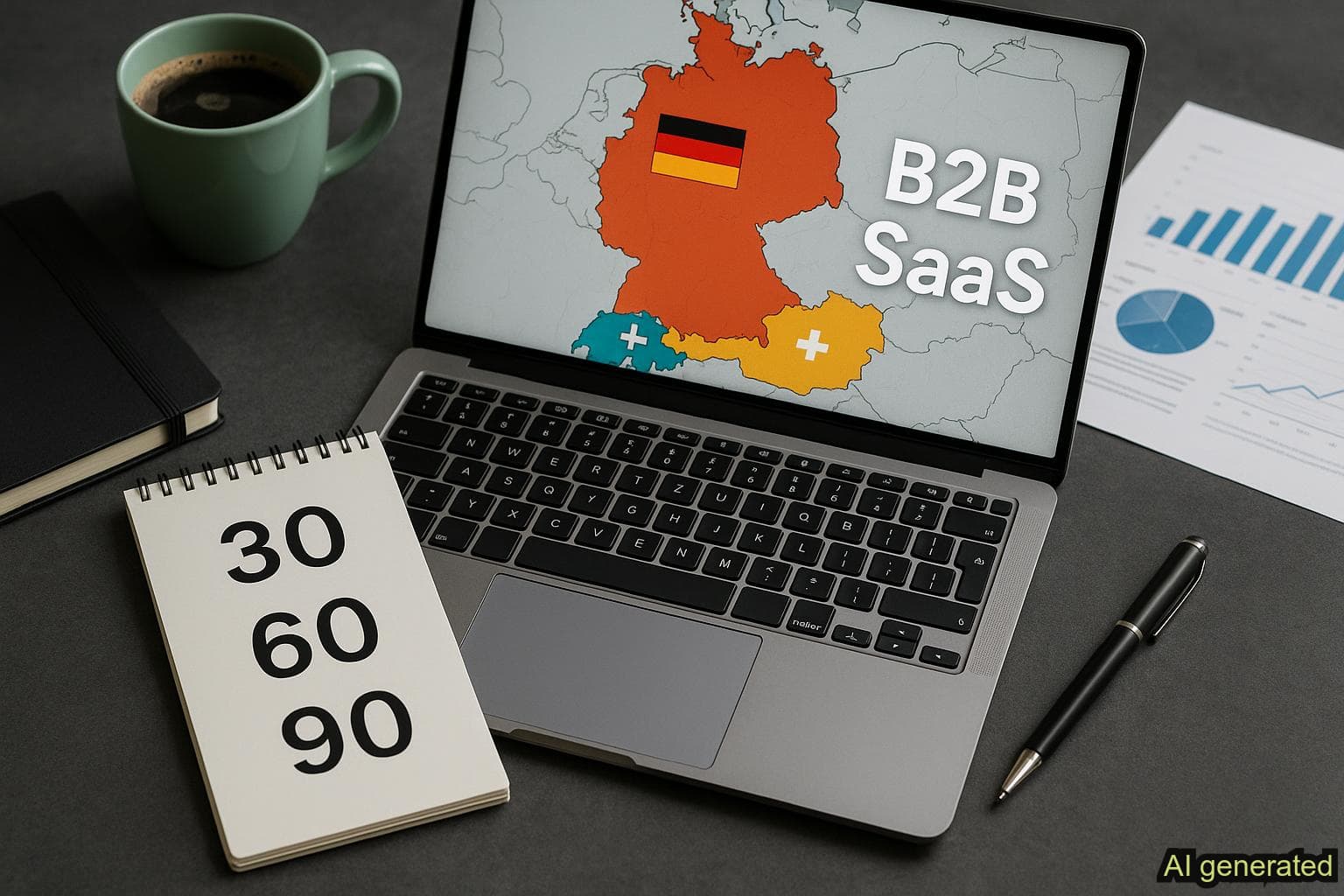
How to Structure Your B2B SaaS Entry Into DACH Without Betting Your Runway on a Local Hire
Entering Germany is not a hiring problem. It's an execution problem. Most founders assume that translating their pitch into German and buying a list of 5,000 contacts counts as a B2B SaaS market entry strategy. It doesn't—it's a fast way to burn trust in a market that punishes shortcuts. German B2B buyers expect four to six touchpoints before they take a call seriously, and they check for local presence before they check anything else about your offer. That's not a cultural quirk to work around. It's the actual rulebook. Skip it, and even a great product looks like a stranger knocking on the wrong door. Follow it, and the same product becomes credible within weeks, not years. The difference isn't budget. It's structure.
You face a false choice: either run a DIY motion that yields silence in a market where home-market playbooks don't translate, or commit €60,000 to a country manager before you know if the market fit exists at all. Neither is necessary. This guide provides a third path—a 30-60-90 diagnostic and execution framework that lets you validate DACH market fit, prove execution capability, and build credibility without betting six figures on a single hire or losing accountability to a consultant. The framework rests on one principle: structure and compliance determine whether founders get booked meetings or silence.
The Execution Problem Disguised as a Market Problem
Why Your Home-Market Sales Playbook Fails in Germany
In your home market—whether India, Southeast Asia, the UAE, or the US—a well-executed B2B cold outreach campaign generates 15–20% reply rates. Buyers respond quickly. The sales cycle moves at velocity. Trust is built through directness and relationship momentum. Then you run the same playbook in Germany. The emails land. The list is clean. The pitch is sound. And nothing happens. Radio silence.
This isn't because the market doesn't work or your product isn't good. German B2B buyers operate under a different protocol. They expect formal, process-driven engagement. They are skeptical by default. They do not respond to urgency or velocity. They interpret fast-paced outreach as unprofessional. They require multiple touchpoints spaced weeks apart, not days. They verify local credibility before they even consider taking a call. When your home-market playbook treats DACH like another geographic expansion, the buyer experience is equivalent to running a German sales motion in English—it reads as foreign, untrustworthy, and not worth their time.
The difference isn't budget. It's structure. The difference isn't product quality. It's execution.
The Four-to-Six Touchpoint Sequence German B2B Buyers Expect
German B2B buyers operate on a specific protocol. This is not a preference. This is the rulebook separating booked meetings from inbox silence. The protocol spans four to six touchpoints, spaced weeks apart, each serving a distinct purpose and formality level.
Touchpoint one is research-based outreach. You've done homework on the company, identified a specific business problem, and you're opening a conversation, not making a pitch. The tone is formal. The value proposition is presented as a question, not a claim. The call-to-action is a conversation, never a demo or trial.
Touchpoint two arrives 10–14 days later. It's not a follow-up; it's a new angle or proof point—a case study from a similar German company, a reference call with a peer, an invitation to a webinar addressing a topic they care about. The tone remains formal. The spacing is deliberate. The goal is to move from stranger to legitimate-enough-to-consider.
Touchpoints three through six follow the same pattern: 10–14 day intervals, new angle or proof point each time, formal tone, conversational goal—not a close. By touchpoint four, credibility has been established enough for a German buyer to take a call. By touchpoint six, they expect it. This pattern isn't unique to DACH. This is how B2B procurement works across Germany, Austria, and Switzerland.
Your home-market playbook collapses the timeline, drops the formality, and treats each touchpoint as a conversion opportunity rather than a trust-building step. The result is predictable: silence in Germany. Not because the market is closed, but because you're not following the rulebook.
Your 30-Day Diagnostic: Build a Market Entry Baseline
Before running outbound, before hiring, before committing budget or runway, spend 30 days running a diagnostic. This isn't a research phase. It's a structured self-assessment answering three critical questions: Do we understand the German buyer better than our home-market buyer? Are we credible enough to enter this market, or do credibility gaps require attention? Do our systems (CRM, email, data infrastructure, compliance framework) support compliant B2B outreach in the EU?
Define Your Buyer Persona in DACH—Not an Export From Home Market
Your home-market buyer persona doesn't transfer to Germany. Not because German buyers are different people, but because market structure, buying authority, budget allocation, and decision-making timelines differ fundamentally. A Director of IT Procurement in India may have unilateral authority to approve a €30,000 software contract. In Germany, that director is one of four stakeholders. The procurement process is documented. The approval chain is fixed. The timeline is longer. The skepticism is higher.
Run this diagnostic for your primary buyer title in Germany: (1) Who else has to approve this purchase? (2) What is the typical evaluation timeline? (3) What are the three to five questions this buyer will ask before taking a call? (4) What social proof or local reference matters most to this buyer? (5) How much does this buyer know about your company or category before you reach out?
If you cannot answer these questions from German market research or German customer conversations, you don't yet have a German buyer persona—you have an assumption. Conduct research through LinkedIn, German business forums, analyst reports specific to DACH, or conversations with German procurement professionals before building your outreach.
Audit Your Positioning Against German Competitor Perception
German buyers research vendors extensively before taking a call. They check your website, look for local case studies, search for local references or customer logos, and assess whether you have a visible commitment to the German market. When they find none—no German case study, no German customer, no local phone number, no team member understanding German business norms—they file you away as a speculative outsider attempt. This doesn't preclude a sale. It means they require more touchpoints and more proof than they would demand from a local incumbent.
Your diagnostic: Search for your primary competitor in Germany. What does their website communicate? Do they have German case studies? Do they list German customers? Do they maintain a German office or team? Now search for your company. What do German prospects see? The gap between what you project and what competitors project is your credibility deficit. This gap is not fatal—it means your multi-touch sequence must account for it. You'll need more touchpoints. You'll need social proof you don't yet have. You'll need to build local reference customers early. Structure your execution plan around this gap rather than ignoring it.
Compliance Audit Checklist—Move Paralysis to Action
GDPR and EU data regulations are non-negotiable. They are also less complicated than founders fear once you operationalize compliance into your process rather than treating it as a separate legal problem. The distinction between compliant B2B outreach and illegal campaigns is clear once you know the rules. Compliance failure damages trust in a market where trust is earned slowly and lost instantly. Compliance clarity builds credibility within weeks.
| Compliance Area | Question | Guardrail |
| Data Hosting | Where is your prospect data stored? Where is your CRM hosted? | Data must be stored in the EU or on US servers with EU standard contractual clauses. Confirm with your CRM vendor (Salesforce, HubSpot, Pipedrive). Non-compliance here is non-negotiable. |
| Email Infrastructure | Does your email platform comply with GDPR? | Use vendors with explicit GDPR compliance certification. Do not use purchased lists without vendor confirmation they were collected with explicit consent or B2B legitimate interest. Verify before sending. |
| Data Source | Where does your prospect list originate? LinkedIn scraping? Purchased list? Company website? | B2B legitimate interest (company contact lists, publicly available business data) is permissible under GDPR. Purchased consumer data or scraped lists without consent are not. If unsure about your source, do not send. |
| Outreach Messaging | Does your email contain opt-out language, real sender identity, and clear value proposition? | Unsubscribe link required. Sender identity (real company name, real sender email) required. If the email reads like spam or hides the sender, it poses compliance and deliverability risk. Test email copy before sending at scale. |
| Vendor Contracts | Do your vendors have data processing agreements (DPAs) in place? | Request a DPA from any vendor that touches prospect data. Most vendors have one. If not, find a new vendor. This is the legal backbone of your compliance framework. |
Run this checklist in your first two weeks. If you find gaps—data not in EU, vendor lacks DPA, email tool lacks GDPR compliance—address them before running outbound. The cost of fixing these gaps now is €0–5,000. The cost of a compliance failure after sending 5,000 emails to a purchased list is reputation damage and potential enforcement action. Compliance clarity baked into your process becomes a competitive advantage. Founders running tight, documented compliance frameworks build trust faster in regulated markets because they're visibly doing the right thing.
The 60-Day Execution Framework: Structure Over Improvisation
By day 30, you have a validated German buyer persona, mapped your credibility gaps, and audited your compliance posture. By day 60, you're running the motion. This section provides the roadmap: how to segment your opportunity, structure your multi-touch sequence, and operationalize compliance so it accelerates rather than delays execution.
Segment Your TAM and Select Your First Vertical—Concrete Decision Rules, Not Assumptions
Do not try to sell to all of Germany in your first 90 days. Do not spread effort across five vertical markets or six buyer personas. You will get silence and misinterpret it as market rejection when the real problem is diffused effort. Your first 60–90 days must focus on one vertical and one buyer persona. The decision rules are straightforward: Which vertical has the highest likelihood of response in Germany? Which has the shortest buying cycle? Which segment can you reach efficiently without massive paid spend?
Answer these three questions to select your first vertical: (1) In your home market, which vertical or customer segment has the highest response rate, shortest sales cycle, and most enthusiastic customers? (2) In Germany, does this vertical face similar business problems? (3) Can you build a list of 200–300 prospects in this vertical without purchasing a generic broker list?
If you answer yes to all three, that's your first vertical. Start there. Once you have five to ten qualified meetings and early signals that German buyers in this segment value your offer, expand to a second vertical. This approach cuts execution risk by 80% because you're not diluting effort across the market, and you're building credibility through focus and results rather than spray-and-pray outreach.
Build Your Multi-Touch Sequence Respecting German Buying Protocol
Your multi-touch sequence is the core of your execution framework. Each touchpoint has a specific purpose, formality level, and goal. Do not deviate from this structure. The difference between booked meetings and silence is respecting this protocol.
- Touchpoint One (Day 1): Research-based outreach. Personalized email referencing a specific business challenge at their company. Formal tone. One-sentence value proposition. Call-to-action: would they be open to a 15-minute call to explore this? No demo offer. No urgency. No discount.
- Touchpoint Two (Day 12): Social proof or new angle. A German case study showing similar companies gaining measurable benefits. Or an invitation to speak with a German reference customer. Formal tone. New information, not a repeat of touchpoint one. Goal: move from stranger to credible enough to consider.
- Touchpoint Three (Day 26): Third-party validation or industry insight. An analyst report. An article addressing their industry challenge. A webinar on a related topic. Formal tone. Still no ask for a call—just continue building evidence this is worth their attention.
- Touchpoint Four (Day 40): Direct value connection. Reference to their company size, industry vertical, or known business problem. Why other companies like theirs chose to evaluate your offer. Friendly but still formal. Soft re-engagement: if this resonates, let's talk.
- Touchpoint Five (Day 54): Limited-window opportunity tied to value, not scarcity. Example: We're running a benchmarking study with five similar companies in your sector. Would you be interested in seeing preliminary results? This creates a legitimate reason to respond without artificial urgency.
- Touchpoint Six (Day 68, if needed): Final outreach. Acknowledge that your earlier emails may not have been relevant. Offer a different angle or different stakeholder (perhaps their finance director instead of operations). Leave the door open for future contact without pressure.
The tone across all touchpoints is formal, not conversational. Use Sie (formal you) in German outreach, not Du. Reference specific business outcomes, not features. The spacing is fixed—12, 14, 14, 14, 14, 14 days between touches. Do not compress the timeline. Do not vary the sequence based on intuition. German buyers expect consistency and structure. Give it to them.
Operationalize GDPR Compliance Into Your Weekly Workflow
Compliance stops being a bottleneck the moment you build it into your weekly rhythm. Assign one person to own three things: (1) Data quality and source verification—review your prospect list source weekly and confirm it complies with the guardrails from your 30-day audit. (2) Email copy review—before sending any batch, verify it meets compliance standards: does it have an unsubscribe link? Is the sender identity clear? Does it have a clear opt-out value proposition, not hype? (3) Vendor alignment—are your email tool, CRM, and data vendors all EU-hosted or compliant? Document your DPAs and refresh annually.
Spend 30 minutes each week on this. Document it in a spreadsheet or team post. The act of documentation—writing that you reviewed data sources, tested email for compliance, verified your DPAs—becomes your evidence of diligence. Compliance baked into your process is invisible to buyers, but it protects you and lets you move fast without fear. Compliance bolted on becomes a bottleneck.
The 90-Day Proof Point: Metrics That Matter
By day 90, you need clarity: does this market work, or do we pivot? The answer isn't determined by intuition. It's determined by specific metrics indicating whether execution is working.
Weekly Activity Transparency vs. Vanity Metrics
Track these metrics weekly: (1) Emails sent (your volume). (2) Reply rate (replies divided by emails sent—aim for 8–12% in DACH if your list and copy are sound; this is lower than home markets and that's correct). (3) Booked meetings (the only metric that matters). (4) Time to first reply (how long before a German prospect responds? Expect 10–14 days average; anything under a week is exceptional). (5) Booked meeting rate (booked meetings divided by conversations started).
Do not track: impressions, brand mentions, website visits, email opens, or clicks. These are vanity metrics—they tell you people saw your email, not whether they think it's worth their time to talk to you. A booked meeting is the only proof that execution is working. If you're not booking meetings by day 60, the problem is execution (formality, timing, list, value proposition, compliance posture), not market fit. Pause and re-run the diagnostic questions from H2. If you are booking meetings at a 3–8% rate (booked meetings as a percentage of meaningful conversations), you have proof of execution capability. Decide whether to scale or pivot vertical.
Early Signals of Product-Market Fit in DACH
A booked meeting in Germany doesn't look like one in your home market. German buyers accept calls for one reason: they have questions. They want to understand your offer, verify credibility, and assess whether deeper evaluation makes sense. They do not accept calls to be closed. They accept calls to research. Expect 45-minute conversations where the buyer asks detailed questions, requests references, and makes no commitment on the first call. This is not a failure. This is the German buying process.
By day 90, use this framework to interpret results: If booked meeting rate is 3–5% and German buyers take 45–60 minute calls asking detailed questions, you have early product-market fit. Continue investing. If booked meeting rate is under 1% or German buyers decline calls after taking them, you have an execution problem (wrong buyer persona, wrong value proposition, or weak list quality). Pivot the vertical or buyer persona rather than the market. If you have five or more qualified meetings with zero progressing past the first call, your offer may not fit German market dynamics. Validate this before scaling.
The Credibility Shortcut—Removing the Local Hire Prerequisite
How Structured Execution Replaces Local Team Signaling
German buyers check for local presence, but local presence doesn't require a full headcount. A founder in India running a structured, compliant, multi-touch motion with evidence of German market knowledge (formal tone, 4–6 touchpoint sequence, German case studies or references) builds credibility as effectively as a German country manager—without the €60,000 annual commitment before proving market fit. A local hire signals long-term commitment. Structured execution signals you understand the market. Both build trust; one costs nothing upfront.
This is not a long-term strategy. Once you've proven market fit (50+ booked meetings, 10%+ conversion to early sales conversations, product feedback indicating German buyers see value), hiring a local team member makes sense. That person accelerates relationships, owns ongoing customer success, and deepens market presence. But that hire happens after you know the market works, not before.
Decision Framework—When to Hire, When to Outsource, When to DIY
- DIY (with guardrails): If you have bandwidth and German language skills or can hire a fractional resource for execution and compliance, structured DIY is the lowest-cost option and maintains control. Guardrails: non-negotiable compliance checklist from your diagnostic, weekly activity tracking against the metrics above, clear success metrics by day 90 (booked meetings, response rate by vertical, meeting-to-call progression). DIY works if you can commit 10–15 hours per week to execution and follow the 4–6 touchpoint protocol without deviation.
- Outsource execution: If bandwidth is the bottleneck and you can't hire fractional German speakers, outsource to a partner who owns execution end-to-end. Non-negotiable criteria: the partner takes responsibility for compliance, reports weekly on booked meetings (not activity volume), gives you visibility into the outreach sequence and list, and agrees to clear success metrics by day 90. This costs €3,000–8,000 per month depending on volume, but you maintain strategic control and have clear accountability.
- Hire locally: Only after 90 days of structured execution proves market fit and you have conviction the market justifies the six-figure commitment. Use the diagnostic framework and metrics above to make this decision, not intuition. A local hire without proof of fit is runway gambling disguised as expansion strategy.
The most common mistake is skipping structured execution and hiring locally too early. The second most common mistake is outsourcing to a consultant who hands off a strategy deck and expects you to execute alone. Neither works. Structured execution, whether DIY, outsourced, or hybrid, is non-negotiable. The decision of who runs it is tactical.
Conclusion: Structure Replaces Runway Gambling
You don't need to bet €60,000 on a country manager or €15,000 on a strategy consultant to enter Germany. You need to structure your execution and respect the market's rules. German B2B buyers follow a specific protocol: 4–6 touchpoints, formal tone, proof of credibility before a call, compliance-first outreach. Founders who follow this protocol see booked meetings within 60 days. Founders who translate home-market playbooks see silence and misinterpret it as market rejection.
The 30-day diagnostic (buyer persona validation, credibility audit, compliance checklist) removes guesswork. The 60-day execution framework (focused vertical, multi-touch sequence, operationalized compliance) removes improvisation. The 90-day proof point (booked meetings, response rate, meeting-to-call conversion) removes ambiguity. This process costs time, not money. It de-risks the market entry decision. It lets you prove execution capability before committing six figures. It lets you say to your board, investors, and yourself: we didn't guess. We structured. We measured. We validated. Now we know.
Download the DACH Market Entry Diagnostic Worksheet to run your 30-day assessment. Identify strategic opportunities, compliance gaps, and execution readiness without a sales call. Use the framework in this guide to structure your 60-day motion. Track the metrics that matter by day 90. Then decide: continue investing, pivot vertical, or this market isn't right. You'll have data, not assumptions. That changes everything.